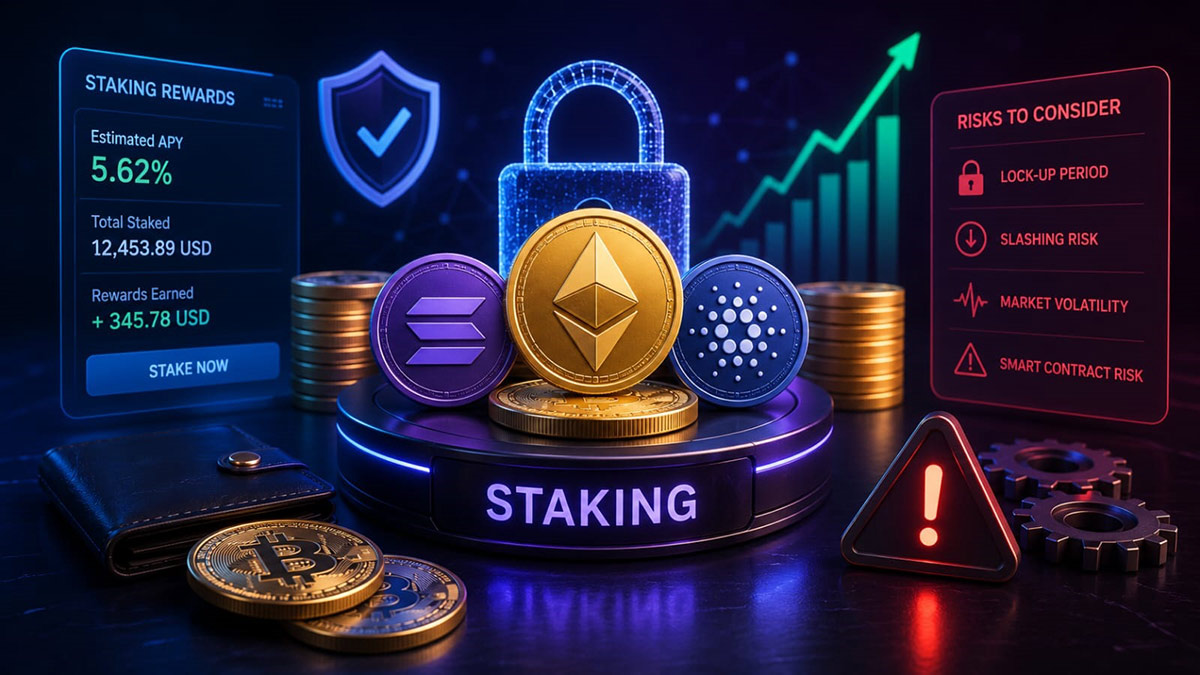
Staking lets you earn rewards just for holding certain cryptocurrencies — but it's not free money. Here's how it actually works, the different ways to do it, and the real risks worth understanding first.
Staking is one of the most common ways to earn a return on crypto you're already holding, and it's become even more relevant this year as major holders — from individual investors to billion-dollar treasury companies — lean on staking to generate yield rather than letting their holdings sit idle. But "staking" gets used loosely to describe a few genuinely different things, and the risks vary a lot depending on which version you're using. Here's a clear breakdown.
What staking actually is
Many blockchains — Ethereum among them — use a system called proof-of-stake to validate transactions and secure the network. Instead of miners solving computational puzzles (proof-of-work, the system Bitcoin uses), validators lock up, or "stake," a chunk of the network's native cryptocurrency as collateral. In exchange for helping validate transactions honestly, validators earn rewards, paid in that same cryptocurrency. If they act dishonestly, they risk having a portion of their staked funds destroyed — a penalty called "slashing."
When you stake as an everyday holder, you're typically not running a validator yourself. Instead, you're delegating your tokens to a validator (or a pool of them), and earning a share of the rewards they generate, minus a fee.
The three main ways to stake
1. Solo staking
Running your own validator node. This gives you full control and the largest share of rewards, but it typically requires a substantial minimum amount of the asset (32 ETH, for example, in Ethereum's case), technical setup, and reliable uptime — a barrier to entry that puts this option out of reach for most casual holders.
2. Pooled / liquid staking
Liquid staking protocols let you stake any amount by pooling your tokens with other users. In return, you typically receive a "staked" token representing your position (for example, staking ETH might return a token like stETH), which you can trade or use elsewhere in DeFi while your original stake keeps earning rewards. This flexibility is a major reason liquid staking has grown quickly — you're not locking up capital you can't touch.
3. Exchange staking
Many centralized exchanges let you stake directly from your account with one click. It's the simplest option by far, but it also means trusting the exchange to actually stake your funds correctly and hold custody responsibly — you're not interacting with the blockchain yourself.
What can go wrong
Staking is often marketed as close to risk-free "passive income," but that undersells it. Worth understanding before you stake anything:
- Price risk doesn't go away. Staking rewards are usually paid in the same asset you staked. If that asset's price falls faster than your reward rate, you can still lose money overall.
- Lock-up periods. Some staking arrangements require an "unbonding" period — often days to weeks — before you can withdraw, during which you're exposed to price moves you can't react to.
- Slashing risk. If your validator (or the pool you're delegated to) misbehaves or goes offline at the wrong time, a portion of the staked funds can be penalized — this is rare with reputable, established validators, but it isn't zero.
- Smart contract risk. Liquid staking protocols and staking pools run on code. Bugs or exploits in that code have caused real losses in DeFi before, so the protocol's track record and audit history matter.
- Counterparty risk with exchanges. Exchange staking is easiest, but it means your funds are custodied by that exchange. If the exchange has solvency issues, staked funds are exposed to the same risk as anything else held there.
Why it's getting more attention right now
Staking has moved from a niche activity to something institutional players are building entire strategies around. Some of the largest corporate holders of Ethereum, for instance, now stake the vast majority of what they hold specifically to generate yield that helps cover their own financial obligations — a sign of how mainstream the practice has become, well beyond individual retail investors clicking "stake" on an app.
The bottom line
Staking can be a reasonable way to put idle crypto to work, but it's not the "free yield" it's sometimes marketed as. The right approach depends on how much control you want, how much you're staking, and how comfortable you are with lock-up periods and the specific risks of whichever method you choose. As always, understanding what you're actually agreeing to — not just the advertised reward rate — is the difference between an informed decision and a costly surprise.